Mexican Beetle 1600i
Fuel Injection
System
Ignition
Timing
Version
1.00
Phil Ade
2005
Table of
Contents
2.0 Setting the Timing on a 1600i Engine
2.1 Connecting up the Diagnostics Kit to the Car
2.4 What to do if the ECU went into permanent emergency mode
1.0 Introduction
The ignition part of the Digifant fuel injection system is generally
(automatically) controlled by the Digifant ECU its self. It consists
of an ignition transformer (rather than an ignition coil), a distributor
and a vacuum unit which is part of the ECU its self.
The distributor its self contains a rotating magnet (fixed to it’s
shaft), hall sensor (instead of contact breaker points) and a rotor arm at
the top of it’s shaft.
This document is intended to cover the correct method of adjusting the
ignition timing of a 1600i engine.
The following tools are required to carry out ignition timing on a 1600i
engine:-
-
VAG 1551/1552, VAS 5051/5052/5053 or VAG-COM (essential !!!)
-
Adjustable timing gun
-
A wedge for the accelerator lever on the air intake unit
-
Battery extender
-
10mm socket
-
Short extension bar
-
Ratchet
1.2 Prerequisites
The following must be satisfied before you even attempt to set the ignition timing of a 1600i engine.
-
No faults
reported by the ECU
-
ECU not
running in emergency mode
- Oil temperature least 80°C
IMPORTANT PLEASE READ THIS BEFORE YOU
START!!
Please note that it would be absolutely futile if you try to set the ignition timing without a VAG or VAG-COM fault code reader/programmer.
If you do so, you will seriously risk putting your car’s ECU into emergency mode permanently. This will cause the engine to barely run at all, use lots of petrol and it will get hot very quickly !!
2.0 Setting the Timing on a 1600i Engine
The process of setting the timing of a 1600i engine will now be explained
in separate
sub-sections:-
2.1 Connecting up the Diagnostics Kit to the Car
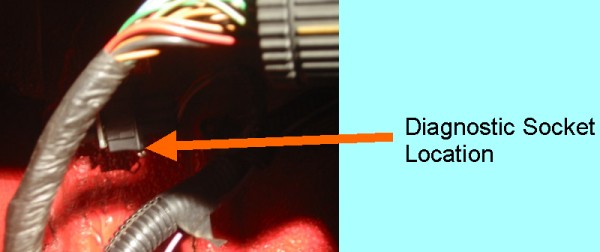
The diagnostic socket on
a mexican beetle 1600i is located in the top left hand side of the rear engine
compartment, which is shown in the photo below:-
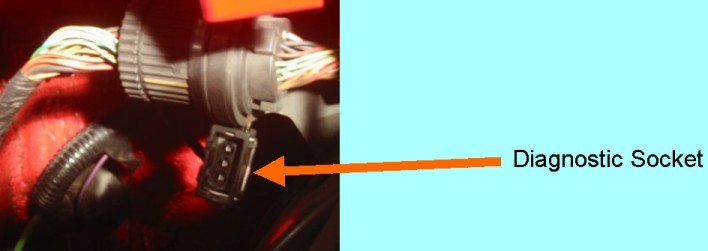
Disconnect this socket from
it’s dummy plug by pressing the metal clip on both sides of the socket
and pull off the socket away from it. You can now get at the diagnostic socket which is shown
below:-
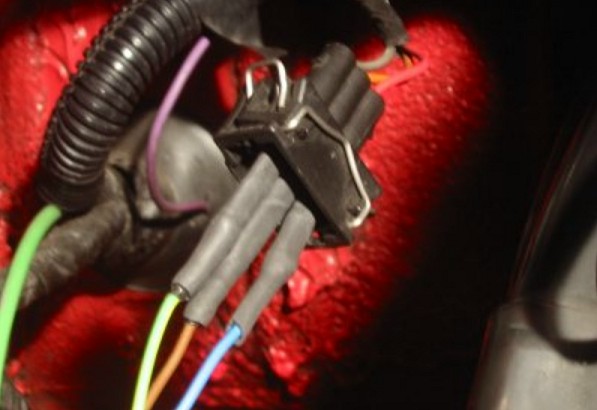
Now connect up your diagnostics
kit to the diagnostics socket. I will be referring to my VAG 1552 fault code reader
throughout this document but the same applies to other diagnostic kits as
well. The photo below shows
my home-made cable being connected to my car’s diagnostics
socket:-
Make sure that you have
connected it the correct way round, where the following applies to the
diagnostics socket:-
| Wire Colour | Purpose |
|
| Red | + 12V | |
| Brown | 0V (Ground) | |
| Grey/White | K-Line Data
(do not short this wire to +12V
!!) |
After you have ensured that
you have connected up your diagnostics cable correctly to the 1600i’s
diagnostic socket, connect up the other end of your diagnostics cable to
your diagnostics test kit.
My home-made VAG 1552 to mexican beetle cable is shown on the next page. I have wired an LED inside the 5 pin 270° bayonet Tuschel plug to indicate that +12V and 0V have been connected the correct way round. This is generally a fail-safe way to protect the K-Line of my VAG 1552.
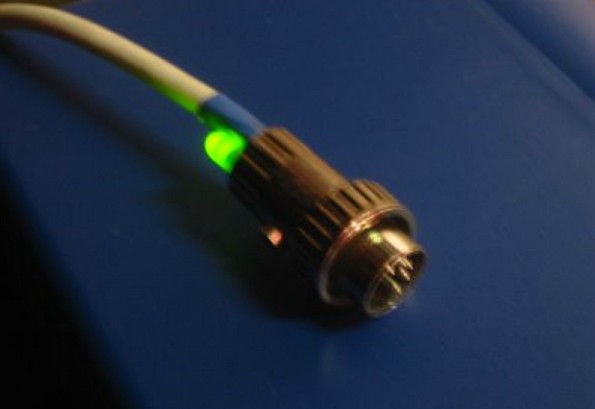
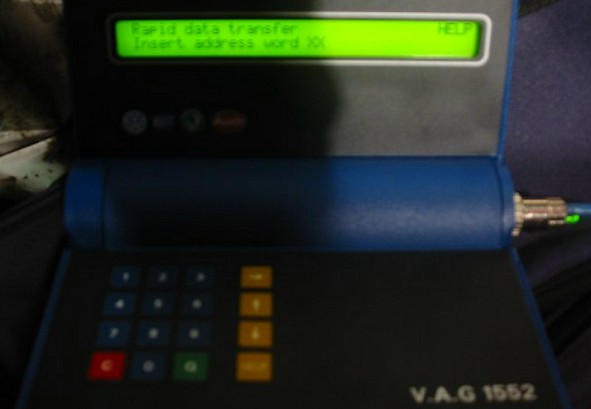
Anyway to those of you who
do not know what a VAG 1552 looks like, here’s a picture of my one
below:-
2.2 Using the Diagnostics Kit
Before
you can use your diagnostics kit to do anything on a 1600i, you must start
up it’s engine and wait for at least 6
seconds.
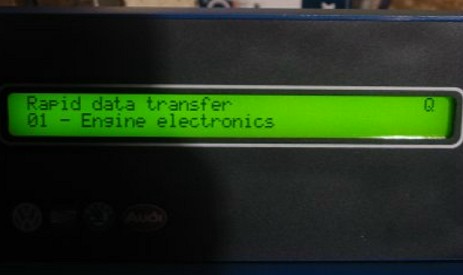
Now type in command
01 – Engine
Electronics
on the VAG 1552 or equivalent and confirm by pressing the
Q key:-
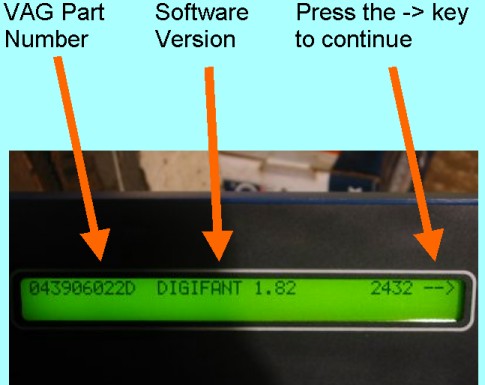
The VAG 1552 will now
interrogate the ECU to find out it’s part number and software version
number which would typically look like the photo below (in this case I have
the D version of the ECU). This
would normally take about 5 to 10 seconds, possibly longer in the case of
the VAG-COM but I cannot be certain.
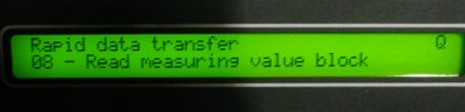
The VAG 1552 will now go
to the enter function screen. Now
enter the command 08 – Read Measuring
Value
Block
followed
by the
Q key:-
The VAG 1552 will now ask
for a Measuring Value Block number, enter
001 followed by the
Q
key:-
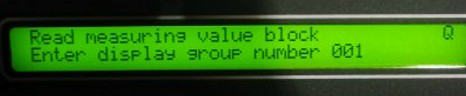
The VAG 1552 will now display
the engine temperature in °C.
Now leave the engine running until the oil temperature
has reached at least 80°C:-
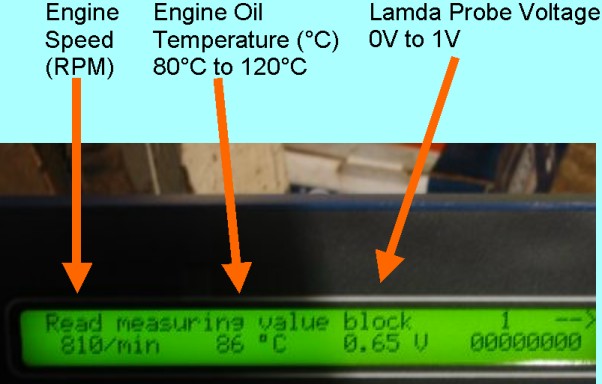
After the engine has reached
operating temperature, you should now check the ECU for
faults. Press the
C key to exit the Read Measuring Value Block
function.
Now check the ECU to ensure
that there are no faults. To
do this enter the command 02 –
Interrogate Fault
Memory
and press the
Q key:-

If there are no faults within
the ECU, the following message will be
displayed:-

If no faults were found
then press the
->
key to go back to the commands menu, otherwise write down what faults were
found and correct them before you continue.
Now enter the command
06 – End
Output,
press the
Q
key and
switch off the engine.
Now connect up the battery
extender from the car’s battery its
self. Here’s a photo of
my home made one which is particularly useful since my timing gun’s
power leads are not long enough:-
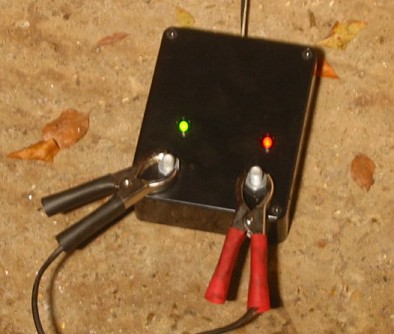
Now connect up the timing
gun to the battery extender and it’s inductive pickup to cylinder 1’s
spark plug lead:-
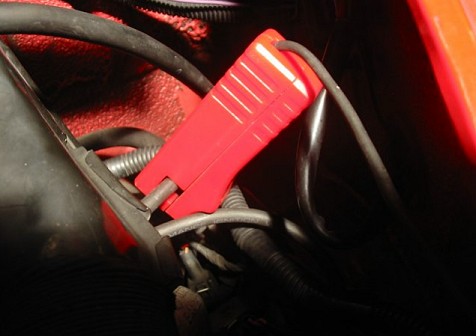
Now adjust the timing
gun’s advance control (which will help you to set the 1600i’s timing
to 6° BTDC according to VW’s Digifant Injection and Ignition System
booklet) to 6° BTDC:-

Notes:
Be careful
when you are adjusting the ignition timing if you have
a
-
01 Engine Electronics (followed by the Q key)
-
08 Read Measuring Value Block (followed by the Q key)
-
001 Read Measuring Value Block 1 (followed by the Q key)
Use a wedge between the
accelerator lever on it’s air intake and the idle end-stop it’s
self to maintain that engine speed.
Please note that the whole timing process must be
completed in less than 30 seconds from here on to avoid the ECU from going
into permanent emergency
mode. If it does, it can
simply be reset by clearing the fault memory, which will be explained
later.
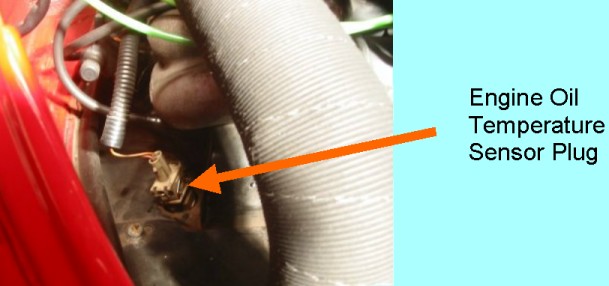
Now locate
the engine oil temperature sensor plug (next to cylinder no. 4) which is
shown below:-
Now have your ratchet, short
extension bar and 10mm socket nearby because you will need them
very quickly indeed
!
Now
press the clips on both sides of the engine oil temperature sensor plug and
pull it off. Immediately pull
the throttle lever back to increase the engine speed back up to 1500 RPM
and hold it there ! The engine
at this point will barely run at all.
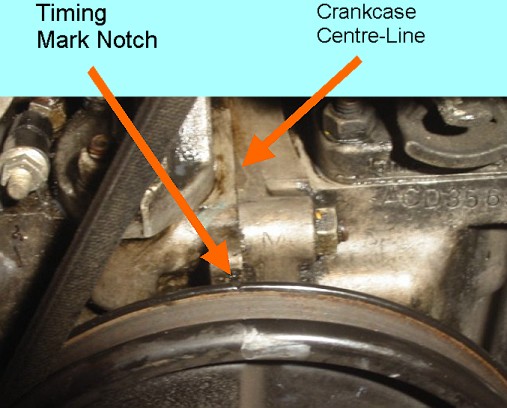
Now immediately aim the
timing gun at the lower crankshaft pulley and check to see if the notch lines
up with the crankcase’s centre-line:-
If the timing is incorrect
then it can be adjusted by slackening the 10mm clamp nut on the distributor
and rotating it:-

After the ignition timing
has been correctly set, immediately tighten up the clamp nut and re-connect
the engine oil temperature sensor. Now let go of the accelerator lever immediately
!!
If the ECU has not gone
into emergency mode the engine will now run
normally.
2.4 What to do if the ECU went into permanent emergency mode
If
the ECU has logged that G27 (the engine oil temperature sensor) has become
faulty, then the ECU will go into permanent emergency
mode. If you do not have a
diagnostics kit then you are pretty much in serious trouble at this point
and should have read section 1.1 !!
To get the ECU out of emergency
mode, do the following:-
-
Press the C key to exit read measuring value blocks.
-
Enter command 02 – Interrogate Fault Memory and press the Q key. The fault on G27 should now be listed. Press the -> key to continue.
-
Enter command 05 – Erase Fault Memory followed by the Q key to erase the fault memory. The VAG 1552 should now display the message Fault Memory Erased! and the ECU should now exit emergency mode.
3.0 Acknowledgements
I would like to thank following
for their help:-
ErWin – VW Service Department – Technical
Information
for providing
downloadable (paid for and time limited sealed PDFs) documentation on various
aspects of the 1600i engine.
Manfred
Graf for
his great website
http://www.1600i.de/
which has lots of very useful documentation and tips. It has helped me a
lot with various issues with my own 1600i beetle and I would really not know
what to do without it. If anyone
has a problem with his or her 1600i beetle, then this is the website to go
to.
I would also like to thank
him for all of his help too with his CDs in exchange for a copy of my printed
out VW documentation and for giving me various hints and tips too via
email. I would very highly recommend
getting WinETKA since it will allow you to cross-reference 1600i parts with
other VW models, thus making it very easy to order 1600i parts from almost
anywhere.
I would also like to thank
everyone who has participated his 1600i website too, everyone has done a
great job.
3.1 Finally….
I have written this document
as a way of saying thankyou to Manfred for all of his
help. I thought that I could
help others too by writing (in my own words) the english documentation of
the ignition timing for the 1600i beetle engine.